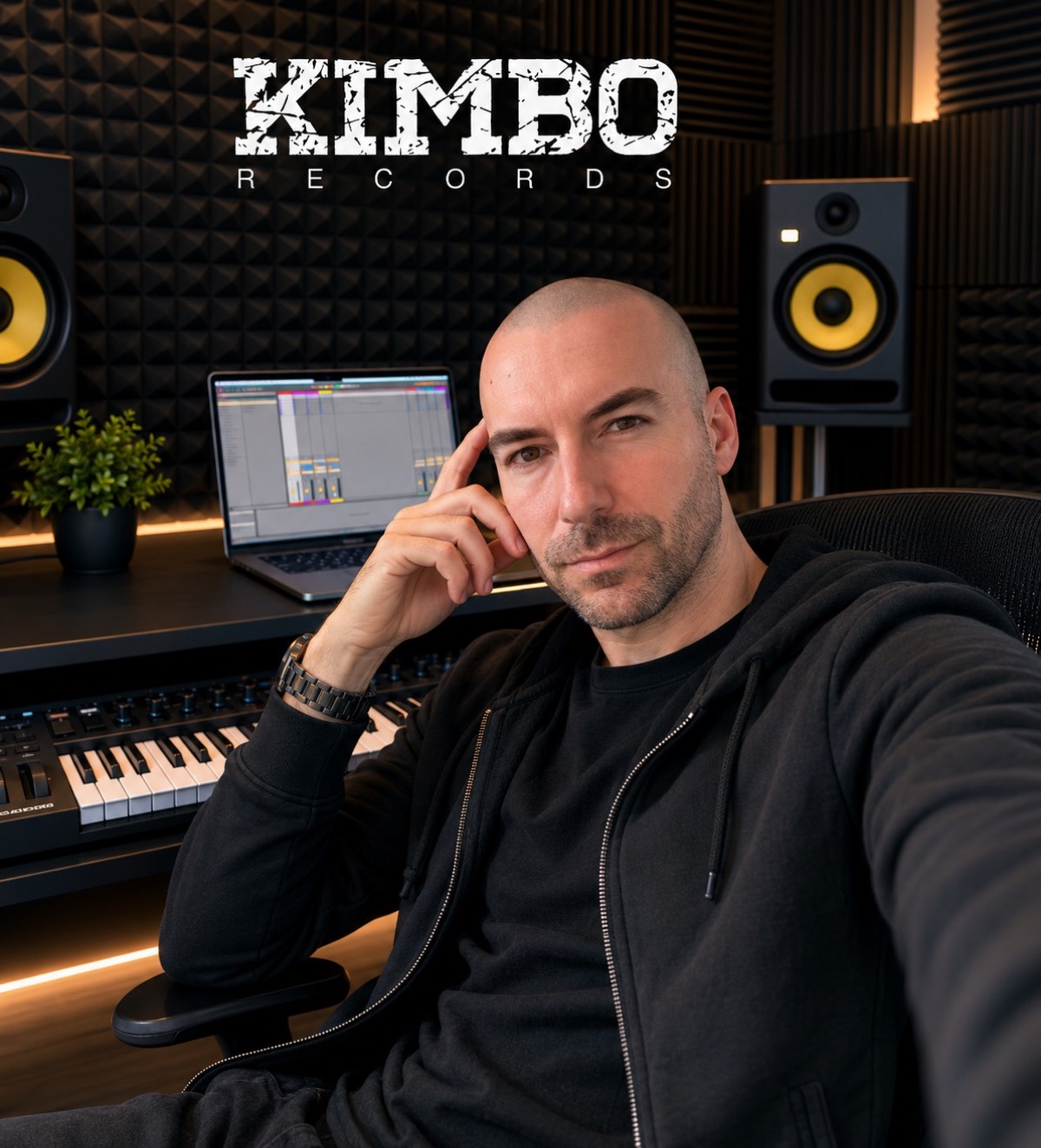
Kimbo Records begins a new chapter in 2026 after several years on pause. Behind its return is Oliversam, producer and founder of the label.
In this conversation for Club Radar, we revisit his first encounters with music, the vinyl and DJ-booth years, some of the defining moments of his career and, above all, the philosophy guiding Kimbo Records into the future: independence, underground culture and artists with an identity of their own.
Before becoming a DJ and producer, what were your first encounters with music?
Music caught my attention from a very young age. Anything that could produce a sound sparked my curiosity.
With almost no musical knowledge, I remember picking up a piano, guitar, trumpet or any instrument within reach and trying to make it sound. I often managed to find small melodies simply by ear.
It was never academic. It was more a need to experiment and discover what I could do with those sounds.
Later, my first Technics turntables arrived. I began buying vinyl, and that was where my path as a DJ truly started.
I think that intuitive way of approaching music is still part of who I am today.
You experienced a particularly important era for house music at close range. How do you remember those years?
I was fortunate to experience what I personally consider one of house music’s most special periods, roughly between 2005 and 2010.
There was enormous creativity and a very distinct musical identity. For me, those were years of constant learning: listening to music, discovering producers, buying records, spending time in clubs and understanding how a dancefloor reacts.
Living through that period from the inside had a huge influence on how I understand electronic music.
Every generation will have its own reference era, but those years had something special for me, and many of those influences remain present in the way I produce and understand music today.
You also released music outside Kimbo Records. What memories do you have of that period?
It was a very important stage for me as a producer.
I had the opportunity to release music on labels including Pacha Recordings, Natural Rhythm and Alma Soul, and to work with international artists such as Horatio, Lützenkirchen and Cagedbaby, who remixed some of my productions.
Those experiences help you grow and, above all, teach you an enormous amount.
One moment I remember especially was “La Vida”, a track made with Carlos Jiménez and J.Elvira. Pacha Recordings became interested in the production and eventually released it, and the track entered the Beatport Top 100.
When you are starting out, achievements like that seem very far away. When they finally happen, the excitement is immense.
I also treasure much simpler but equally special memories. During a Three Kings parade in my small hometown, they began handing out Barceló compilation CDs, and I discovered that one of my productions was included.
It may seem like a small anecdote compared with entering an international chart or releasing on certain labels, but those are often the moments that bring the most joy. Finding your own music where you least expect it is difficult to describe.
Kimbo Records was founded in 2013, but later entered a long pause. Why did you stop the project?
Kimbo Records began in 2013 and was active for several years before that pause.
The reason was quite simple: a lack of time.
My work and other responsibilities reached a point where I could no longer give the label or my production the time they really needed.
I preferred to stop rather than keep a project going without being able to give it enough attention.
But the pause was never caused by losing the desire to make music.
Throughout those years, the wish to return to the studio was always there. I knew that if I ever had the necessary time again, I wanted to recover both my work as a producer and the Kimbo Records project.
What happened in 2026 that made you decide it was time to bring Kimbo Records back?
Mainly, I once again had more time and could return to something I had wanted to recover for many years.
I was eager to get back into the studio, produce new music and revive a project that already had a history of its own.
I also believe the current moment in music makes this return especially interesting.
We are living through enormous change, new technologies, artificial intelligence and trends that appear and disappear at incredible speed.
That is precisely why I believe defending music with identity makes even more sense now.
Kimbo Records was never created to chase trends. We want to release underground music made by artists who truly believe in what they do and produce what genuinely comes from within.
Technology can change dramatically, and surely will continue to do so, but I believe an artist’s personality and identity remain fundamental.
The music market is completely different from the one you encountered in 2013. How has your view of streaming changed?
It has changed enormously.
When Kimbo Records began, streaming still created a great deal of uncertainty. Parts of the industry even felt that it might seriously harm traditional music sales.
Over the years, reality has changed completely.
Streaming has become a fundamental part of the industry, both for discovering new music and for building audiences, visibility and income for many artists.
That is why we want to work much more closely with it during this new stage.
Kimbo Records will remain deeply connected to the specialist electronic music market, digital stores and platforms such as Beatport. At the same time, we are developing and growing the label’s own Spotify playlists.
We want those playlists to gradually become another tool for supporting our releases and giving Kimbo Records artists greater visibility.
It is long-term work. A playlist and a genuine community do not grow overnight, but we want to develop them continuously so they become stronger and create more value for the artists on the label.
Which values do you want to define this new era of Kimbo Records?
Above all, independence, identity and creative freedom.
We want artists who do not make music solely according to whatever happens to be trending.
We are looking for people who have something of their own to say musically and who produce what they truly feel.
Kimbo Records wants to remain independent in the genuine sense of the word: free to release what we believe in.
We do not want to become a music factory designed simply to follow trends or algorithms.
We want to build a catalogue that will continue to represent our way of understanding electronic music as time passes.
Where would you like to see Kimbo Records in five years?
I would like to see it firmly established once again within the international underground scene.
I want to continue working with the artists who are already part of our family while discovering new producers from around the world who share our philosophy.
I would rather it be a label recognised and respected for its identity.
When a DJ, producer or listener sees Kimbo Records on a release, I want them to know that a particular way of understanding music stands behind it.
If we can also use the label’s growth, our playlists, promotion and channels to help our artists reach more people, I believe we will be doing our job well.
You also spent many years behind the decks. Do you miss returning to clubs?
Being a DJ was an incredibly important part of my life, and I have very good memories of it.
The booth teaches you a great deal about music. It allows you to understand the dancefloor, observe people’s reactions and discover things that are difficult to learn inside a studio alone.
Today I am at a different point.
I especially enjoy producing again, working in the studio and dedicating time to growing Kimbo Records.
I never say I will not return to a booth, because music takes many turns, but right now my excitement is focused mainly on this new stage.
Kimbo Records also has artists with extensive club and DJ-booth experience who are perfectly capable of representing the label’s sound and philosophy live.
Before we finish, is there a message you would like to dedicate to everyone who has been part of Kimbo Records?
Absolutely.
I would like to offer my heartfelt thanks to every artist who has trusted Kimbo Records since the beginning.
Every release, demo, remix and shared project has helped build the label’s history.
Kimbo Records would never have become what it was, nor could it return today with such enthusiasm, without all those people who chose to be part of the project.
I also want to thank the DJs, producers, collaborators, media and followers who, in one way or another, helped our music travel further.
This new stage begins with the same excitement as in 2013, but with all the experience gained over the years.
I hope to work again with many of the artists who were part of that first chapter while welcoming new talent who share our way of understanding electronic music.
Thank you for being part of the Kimbo Records story. This return belongs to you too.
A new chapter for Kimbo Records
More than a decade after Kimbo Records was founded, Oliversam returns to the studio with a different perspective, but with a philosophy that has barely changed.
The market is different. The platforms are different. The way music is discovered is different.
But the purpose behind the label remains the same: to release underground electronic music with personality and support artists who would rather build their own identity than chase the next trend.
Kimbo Records therefore opens a new chapter in a story that began in 2013 and, after a long pause, is moving forward again.
Welcome back to the underground.